
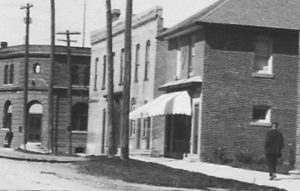
The McDermott Block – 1 Albert Street S
The block quickly became one of Sunderland’s principal commercial centres. In 1872, William Gordon operated a dry goods store in Unit No. 2, selling groceries and ready-made clothing. Dr. James McDermott also operated a drugstore in the block.
As Sunderland grew, the businesses occupying the complex changed. By 1904, the ground floor included a bank, post office, furniture store and several other shops. A 1910 map shows the post office and drugstore still operating, along with a grocery store and offices. Thomas Welsh was postmaster in 1910, while by 1913 Harry Baldwin operated a drugstore with a telegraph office next door.
Over time, the complex became known as the McDermott Block. By 1949, it was still a busy part of Sunderland’s commercial centre. Jack Allin was postmaster, with Harry Brandon delivering the mail. George Clay operated a restaurant and ice cream parlour, Clayton Henderson ran a barber shop and billiard hall, and Neil D. McFadden had a store and butcher shop. Families also lived in residences within the complex.
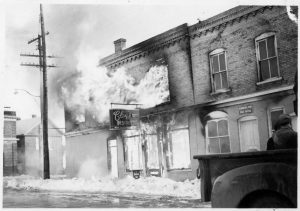
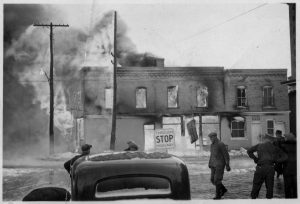
On the morning of the Great Sunderland Fire in 1949, George Clay left his restaurant and walked to Doyle’s General Store to buy butter from clerk Mabel Wright. While he was there, neighbours alerted him that his restaurant was on fire.
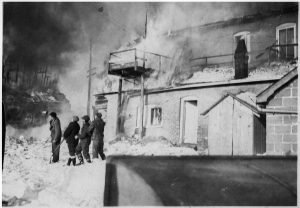
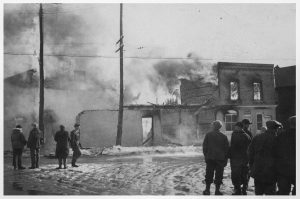
The blaze, which began at about nine o’clock that morning, spread rapidly through the McDermott Block. Within three hours, the entire complex was gone. Five stores and businesses were destroyed along with several residences, leaving families homeless with little more than the clothes they were wearing.
Fire crews arrived from neighbouring communities to help. With winter limiting access to water, holes were cut through the ice of the nearby Beaver River so firefighters could obtain the water needed to keep the flames from spreading to the surrounding buildings.
Throughout the village, residents joined the effort. Volunteers climbed onto slippery rooftops and used buckets of water and even handfuls of snow to extinguish burning embers. At Doyle’s nearby egg-grading station, human chains formed to carry chickens, eggs and supplies away from danger. Men also pushed a threatened wall inward toward the burning McDermott Block to prevent it from collapsing onto neighbouring property.
The fire caused an estimated $200,000 in damage. The loss was so extensive that the McDermott Block was never rebuilt.
A Texaco service station occupied the corner from 1950 until 1984. Bill McDougall later operated a car wash and laundromat on the property, followed by other commercial businesses and restaurants.
Although the buildings themselves disappeared in 1949, the corner of Albert and River streets remains the site of one of the defining events in Sunderland’s twentieth-century history.
Updates
- Special Thanks to Ron Gerrow for donating 4 press photo originals and 5 original 1949 newspapers
- July 11 – 24, 2026 Added 4 HQ scans of photos from original prints
- Added Scan of Globe & Mail article on page 17.
- Added The Evening Telegram Thursday Jan 6 1949 on pages 1,2
- Added Toronto Daily Star on pages 1, 2 and 3
- Added The Evening Telegram Friday Jan 7 1949 Page 3
Newspaper Articles
2. Saint Andrews United Church – 10 Church St N
3. Sunderland Town Hall – 120 River St
4. Dr. Joseph Henry Oliver Home – 128 River St
5. St. Mary’s Anglican Church – 134 River St
6. Dr. James McDermott Home – 160 River St
7. The Fogg House – 198 River St
8. The Blacksmith Shop – 135 River St
9. The Nipissing House Hotel – 123 River St
10. Stop 4 Variety – 111 River St
11. The Old Drug Store – 108 River St
12. The Gigantic Hand Saw, Guardian Pharmacy – 103 River St
13. Fresh Mart – 97 River St
14. The Beall Block – 93 River St
15. The Harness Shop – 89 River St
16. Taylor’s Store – 85 River St
17. The William Doble Home – 32 Albert St
18. The Sunderland Presbyterian Church – 5 Albert St
19. Doyle’s General Store – 3 Albert St
20. The McDermott Block – 1 Albert Street S
21. The Sunderland Telephone Company. – 63 River St
22. James Doble Home – 3 Cedar St S
23. William Nassau Doble Home – 12 River St
24. Thomas Welsh Home – 20 River St
25. Robert Doble Home – 48 River St
26. The Bank – River Street (CIBC) – 74 River St
27. The Brock House Hotel – 82 River St
28. The Hardware Store – 92 River St
29. The Early Undertaker – 96 River St
30. The Printing Shop – 98 River St
31. The Magic Door – 100 River St
32. The Sunderland Legion – 104 River St
33. 108 River Street – 108 River Street
34. “Old” Fire Hall – 5 Church St N
35. The Sunderland Memorial Arena – 20 Park St