
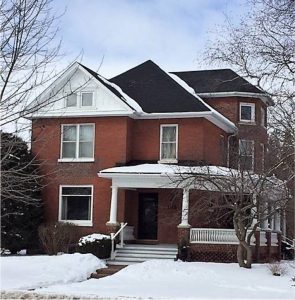
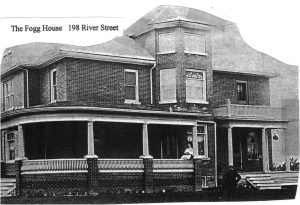
The Fogg House – 198 River St
The Fogg House is a fine example of the elaborate residential architecture popular around the turn of the twentieth century. Its exterior features a sweeping veranda, three-storey bay windows and a number of stained-glass windows.
Much of the original craftsmanship was also evident inside the house. Oak panelling and wainscoting were used in the dining room and front hall, with ash wainscoting in the kitchen. The ceilings were finished with decorative pressed-tin panels, a popular feature of the period. An oak staircase featured turned spindles and newel posts, while the floors were constructed of pine boards.
The Fogg family’s fortunes eventually changed when Thomas Fogg lost much of his money through stock market investments. What became of him afterward is unknown, but his wife and daughter remained in the house and struggled to meet the mortgage payments.
By 1936, the house stood empty and was offered at auction, but no buyer came forward. It was later purchased and shared by members of the Banbury family—Armour and Enid, Martin and Lorne, and Grace. Subsequent owners included Stanley Doble; Fred and Mabel Wilson; and Gordon Lockey, a geography teacher at Brock High School.
In 1967, another Brock High School teacher, Bill Yarima, moved into the house with his wife Joan and their four children. The Yarima family undertook the restoration and careful maintenance of the property, helping preserve many of the original features that make the Fogg House an important reminder of Sunderland at the beginning of the twentieth century.
2. Saint Andrews United Church – 10 Church St N
3. Sunderland Town Hall – 120 River St
4. Dr. Joseph Henry Oliver Home – 128 River St
5. St. Mary’s Anglican Church – 134 River St
6. Dr. James McDermott Home – 160 River St
7. The Fogg House – 198 River St
8. The Blacksmith Shop – 135 River St
9. The Nipissing House Hotel – 123 River St
10. Stop 4 Variety – 111 River St
11. The Old Drug Store – 108 River St
12. The Gigantic Hand Saw, Guardian Pharmacy – 103 River St
13. Fresh Mart – 97 River St
14. The Beall Block – 93 River St
15. The Harness Shop – 89 River St
16. Taylor’s Store – 85 River St
17. The William Doble Home – 32 Albert St
18. The Sunderland Presbyterian Church – 5 Albert St
19. Doyle’s General Store – 3 Albert St
20. The McDermott Block – 1 Albert Street S
21. The Sunderland Telephone Company. – 63 River St
22. James Doble Home – 3 Cedar St S
23. William Nassau Doble Home – 12 River St
24. Thomas Welsh Home – 20 River St
25. Robert Doble Home – 48 River St
26. The Bank – River Street (CIBC) – 74 River St
27. The Brock House Hotel – 82 River St
28. The Hardware Store – 92 River St
29. The Early Undertaker – 96 River St
30. The Printing Shop – 98 River St
31. The Magic Door – 100 River St
32. The Sunderland Legion – 104 River St
33. 108 River Street – 108 River Street
34. “Old” Fire Hall – 5 Church St N
35. The Sunderland Memorial Arena – 20 Park St