
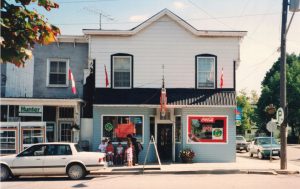
Stop 4 Variety – 111 River St
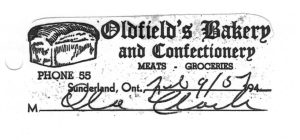
About 1940, the building became Oldfield’s Bakery, operated by brothers Len and Reg Oldfield and their wives. For many years, the Oldfield family supplied Sunderland with groceries and freshly baked bread while also operating an ice cream parlour.
Shopping at Oldfield’s was very different from today’s self-serve grocery store. Customers told the merchant what they wanted, and items were retrieved from shelves behind the counter. Much of the food was sold in bulk and weighed on scales. Vinegar was kept in barrels, with customers bringing their own containers to be filled. Purchases were recorded in a statement book, and many families maintained a running account that they paid when they could.
The bakery produced about 120 loaves of bread each day. Late at night, the oven’s fireboxes were heated so baking could begin early the following morning. Cedar was used to bring the brick oven quickly up to temperature; as the flames died down, the retained heat of the bricks baked the bread.
The Oldfields also maintained delivery routes throughout the surrounding countryside. Bread and other goods were delivered by wagon during warmer weather and by sleigh in winter, with the loaves carried in wooden bread boxes. Farm deliveries sometimes included discreet transactions as husbands hurried out to purchase tobacco without the rest of the household knowing.
The store carried an extraordinary variety of goods—meat, fruit and vegetables, cookies and candy, tobacco products and household groceries. Oranges were specially ordered at Christmas so they could appear in children’s stockings. Even the wooden orange crates were useful and were often transformed into bedside tables or dressing tables.
The ice cream parlour was particularly busy on Saturday nights. Ice cream arrived first in five-gallon metal containers and later in cardboard tubs. A sundae cost 20 cents, a banana split 25 cents and a double-scoop cone 10 cents. Children with only a penny could choose jujubes, black balls or licorice babies, while a chocolate bar cost five cents and a bottle of pop ten cents, plus a two-cent deposit.
Many of these details were preserved by Roy Oldfield, who in January 2008 presented Growing Up in Sunderland, recalling his experiences in the family store between 1949 and 1964.
As shopping habits changed, so did the store. Customers increasingly selected their own groceries, bulk foods gave way to prepackaged products, and glass milk and cream bottles were gradually replaced by newer packaging. The era of the traditional counter-service grocery and ice cream parlour came to an end.
The Oldfield family eventually sold the business to Lauren Frechette, and the building became a butcher shop and grocery before later becoming Stop 4 Variety.
2. Saint Andrews United Church – 10 Church St N
3. Sunderland Town Hall – 120 River St
4. Dr. Joseph Henry Oliver Home – 128 River St
5. St. Mary’s Anglican Church – 134 River St
6. Dr. James McDermott Home – 160 River St
7. The Fogg House – 198 River St
8. The Blacksmith Shop – 135 River St
9. The Nipissing House Hotel – 123 River St
10. Stop 4 Variety – 111 River St
11. The Old Drug Store – 108 River St
12. The Gigantic Hand Saw, Guardian Pharmacy – 103 River St
13. Fresh Mart – 97 River St
14. The Beall Block – 93 River St
15. The Harness Shop – 89 River St
16. Taylor’s Store – 85 River St
17. The William Doble Home – 32 Albert St
18. The Sunderland Presbyterian Church – 5 Albert St
19. Doyle’s General Store – 3 Albert St
20. The McDermott Block – 1 Albert Street S
21. The Sunderland Telephone Company. – 63 River St
22. James Doble Home – 3 Cedar St S
23. William Nassau Doble Home – 12 River St
24. Thomas Welsh Home – 20 River St
25. Robert Doble Home – 48 River St
26. The Bank – River Street (CIBC) – 74 River St
27. The Brock House Hotel – 82 River St
28. The Hardware Store – 92 River St
29. The Early Undertaker – 96 River St
30. The Printing Shop – 98 River St
31. The Magic Door – 100 River St
32. The Sunderland Legion – 104 River St
33. 108 River Street – 108 River Street
34. “Old” Fire Hall – 5 Church St N
35. The Sunderland Memorial Arena – 20 Park St