
The Sunderland Telephone Company. – 63 River St
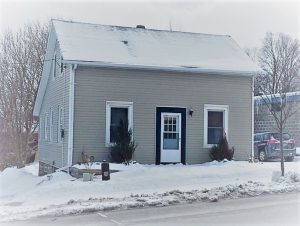
In 1912, the telephone office was located here on the south side of River Street, east of the McDermott Block. The office occupied the front of the building, while at various times the people operating the system lived in the rear.
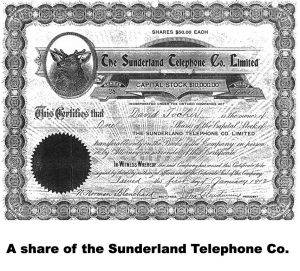
John Glendenning served as president of the company in 1912, with Dr. N. Norman Blanchard as secretary-treasurer. Shares were sold for $50, primarily to local investors, making the telephone system very much a community-owned enterprise.
In 1929, Harry MacGregor, who had banking experience, became secretary-treasurer. William Nassau Doble later gained control of the company by purchasing many of its shares when their value had fallen as low as $20. Doble hired Percy Flagler to maintain the telephone lines, a job Flagler performed from 1930 until 1945.
Around 1945, Cora Doble Moore and her husband, Cecil Moore, operated the telephone office from this building. They worked in the office at the front and lived in the rear of the house until 1947.
Maintaining a rural telephone network required people who knew the lines and could keep them working in all kinds of conditions. Among the repairmen after the Second World War were George Bagshaw, Wayne Kelly, Paul Brandon and Bob Fries. Clarence Young, returning from overseas after the war, later became a repairman in 1957. James Milton Doble served as president, Herb Wilson as secretary-treasurer, and Bruce Toker was also involved in management of the company.
For decades, making a telephone call in Sunderland was very different from today. Callers used a hand-cranked telephone and a combination of long and short rings to reach the operator or another subscriber. Because several households could share the same party line, neighbours could also pick up their receivers and listen to conversations.
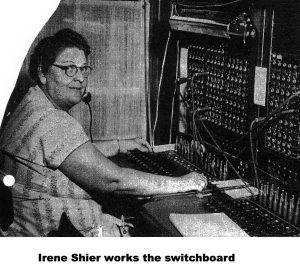
Among Sunderland’s switchboard operators were Minnie Wilson, Annie Fair, Yvonne Sheldon, Irene Shier, Hazel Robertson, Hazel Gorell and Edith Bagshaw. Their role disappeared in 1968 when the local system was converted to dial service. During the changeover, thousands of the old telephones were discarded.
The Sunderland system had also been made compatible with the Bell network, allowing local subscribers to connect with the wider telephone system. Over time, the locally owned company passed through several owners before Bell Canada acquired it in 1980.
Among the last technicians working for the Sunderland Telephone Company were Leslie Brether, Jim St. John and Peter Baker. When Bell took over in 1980, they had to leave Sunderland if they wished to continue their employment.
The former telephone office is now a private residence, but the building recalls a time when Sunderland maintained its own telephone company—and when placing a call began with a crank, a distinctive series of rings and a local operator who connected you by hand.
2. Saint Andrews United Church – 10 Church St N
3. Sunderland Town Hall – 120 River St
4. Dr. Joseph Henry Oliver Home – 128 River St
5. St. Mary’s Anglican Church – 134 River St
6. Dr. James McDermott Home – 160 River St
7. The Fogg House – 198 River St
8. The Blacksmith Shop – 135 River St
9. The Nipissing House Hotel – 123 River St
10. Stop 4 Variety – 111 River St
11. The Old Drug Store – 108 River St
12. The Gigantic Hand Saw, Guardian Pharmacy – 103 River St
13. Fresh Mart – 97 River St
14. The Beall Block – 93 River St
15. The Harness Shop – 89 River St
16. Taylor’s Store – 85 River St
17. The William Doble Home – 32 Albert St
18. The Sunderland Presbyterian Church – 5 Albert St
19. Doyle’s General Store – 3 Albert St
20. The McDermott Block – 1 Albert Street S
21. The Sunderland Telephone Company. – 63 River St
22. James Doble Home – 3 Cedar St S
23. William Nassau Doble Home – 12 River St
24. Thomas Welsh Home – 20 River St
25. Robert Doble Home – 48 River St
26. The Bank – River Street (CIBC) – 74 River St
27. The Brock House Hotel – 82 River St
28. The Hardware Store – 92 River St
29. The Early Undertaker – 96 River St
30. The Printing Shop – 98 River St
31. The Magic Door – 100 River St
32. The Sunderland Legion – 104 River St
33. 108 River Street – 108 River Street
34. “Old” Fire Hall – 5 Church St N
35. The Sunderland Memorial Arena – 20 Park St