
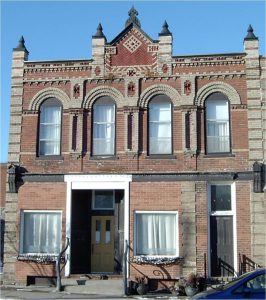
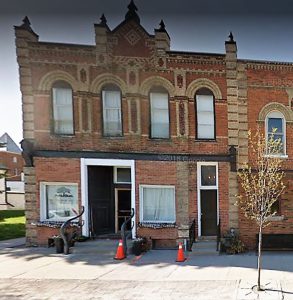
The Magic Door – 100 River St
In 1918, Arthur “Art” Brether moved his barber and tailor business here from a location across River Street near what later became Stop 4 Variety. Brether, who lived from 1870 to 1949, worked as a barber in Sunderland for approximately 35 years.
After Brether retired, Lionel Gervais took over the barbershop and operated a pool hall at the rear of the building. The property later came into the hands of Ralph Pinkham, who converted portions of it into approximately four apartments. Among the residents were Mary Giroux and her husband, Barry O’Neill.
In 1972, Bill Urima purchased the building from Ralph Pinkham and began restoring the front to its original appearance. An art gallery was created from the front apartment and, as tenants eventually left the apartments at the rear, the gallery expanded farther into the building.
The Magic Door Art Gallery and Studio was established in 2001, eventually providing approximately 1,400 square feet of exhibition space.
One notable exhibition featured 36 paintings and murals by Canadian historical artist Lewis Parker depicting the daily life of the Huron-Wendat people. During the exhibition, Parker donated his painting of St. Mary’s Anglican Church to the Sunderland Historical Society, creating a lasting connection between the gallery and Sunderland’s historical collection.
The Magic Door Art Gallery eventually closed, ending another chapter in the building’s long commercial history. Since its construction in 1892, the building has served as a hardware store, barbershop, pool hall, apartments and art gallery—an example of how Sunderland’s historic River Street buildings have continually been adapted to new uses.
2. Saint Andrews United Church – 10 Church St N
3. Sunderland Town Hall – 120 River St
4. Dr. Joseph Henry Oliver Home – 128 River St
5. St. Mary’s Anglican Church – 134 River St
6. Dr. James McDermott Home – 160 River St
7. The Fogg House – 198 River St
8. The Blacksmith Shop – 135 River St
9. The Nipissing House Hotel – 123 River St
10. Stop 4 Variety – 111 River St
11. The Old Drug Store – 108 River St
12. The Gigantic Hand Saw, Guardian Pharmacy – 103 River St
13. Fresh Mart – 97 River St
14. The Beall Block – 93 River St
15. The Harness Shop – 89 River St
16. Taylor’s Store – 85 River St
17. The William Doble Home – 32 Albert St
18. The Sunderland Presbyterian Church – 5 Albert St
19. Doyle’s General Store – 3 Albert St
20. The McDermott Block – 1 Albert Street S
21. The Sunderland Telephone Company. – 63 River St
22. James Doble Home – 3 Cedar St S
23. William Nassau Doble Home – 12 River St
24. Thomas Welsh Home – 20 River St
25. Robert Doble Home – 48 River St
26. The Bank – River Street (CIBC) – 74 River St
27. The Brock House Hotel – 82 River St
28. The Hardware Store – 92 River St
29. The Early Undertaker – 96 River St
30. The Printing Shop – 98 River St
31. The Magic Door – 100 River St
32. The Sunderland Legion – 104 River St
33. 108 River Street – 108 River Street
34. “Old” Fire Hall – 5 Church St N
35. The Sunderland Memorial Arena – 20 Park St