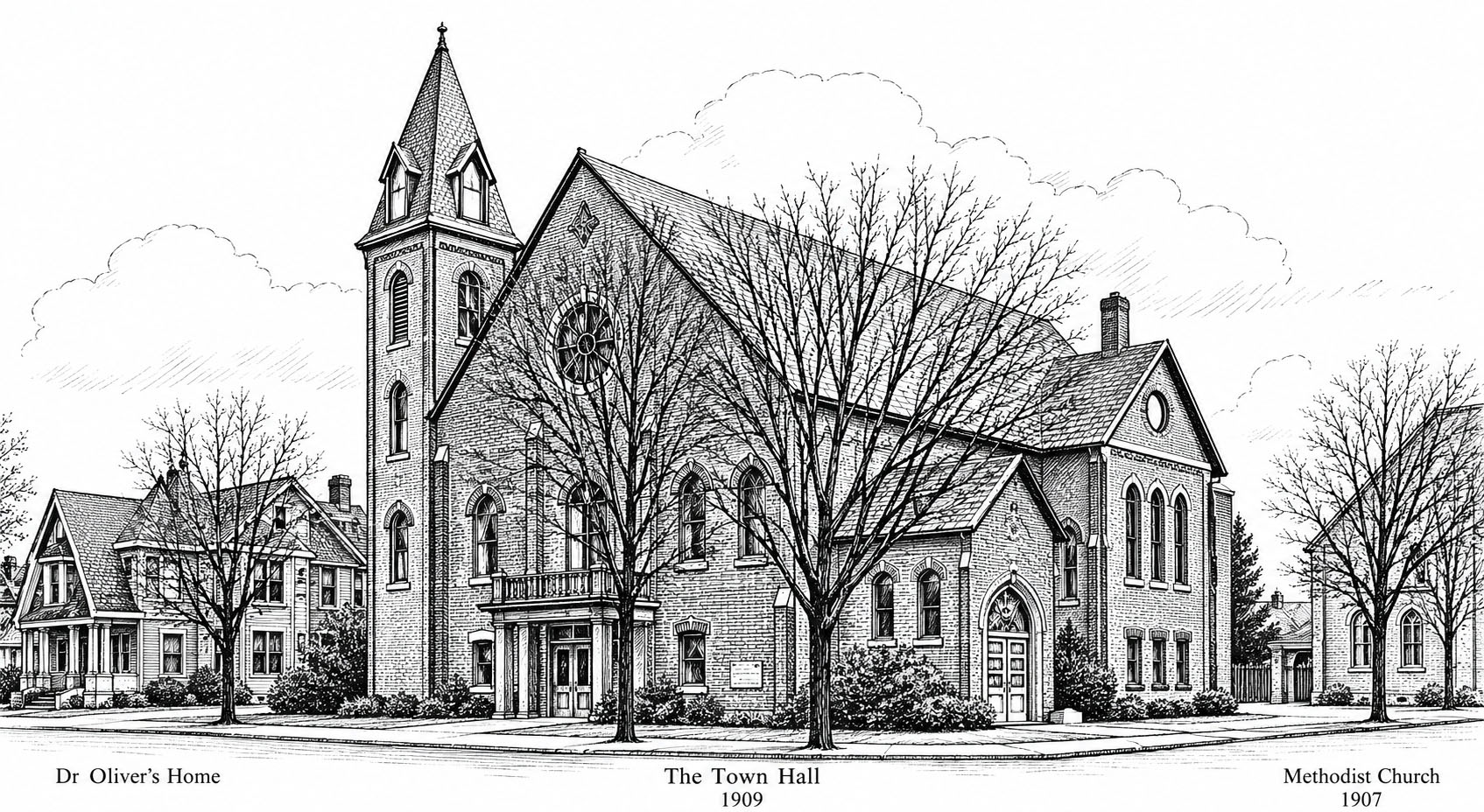
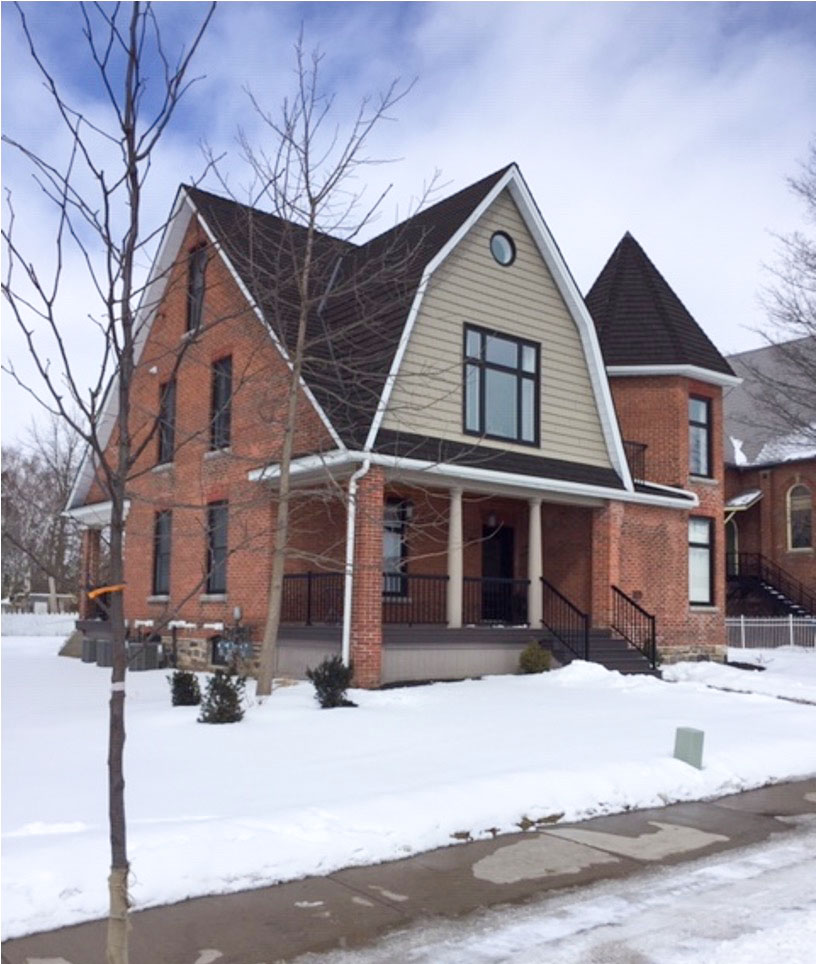
Dr. Joseph Henry Oliver Home – 128 River St
Oliver began his working life as a teacher. After completing high school in Uxbridge, he taught at S.S. No. 4 Ridge School during the 1890s. Among his students was Gus Doyle, who would later become Sunderland’s town constable.
Oliver then began his medical studies in Toronto. After completing his first year, he needed to earn enough money to continue his education and spent several years working as an assistant to a doctor in Northern Ontario. He eventually returned to Toronto, completed his medical training and came home to Sunderland to practise. By 1910, he was listed as a doctor in the Ontario Gazetteer for Sunderland. A surviving receipt for $2 for a mathematics examination also provides an interesting glimpse into his studies at Trinity College in Toronto.
Dr. Oliver’s home at 128 River Street served two purposes. In addition to the family’s living quarters, it contained his medical office, consulting room and dispensary. He also served for a time as Medical Officer of Health for Brock Township.
As a country doctor, Oliver’s practice extended far beyond his office. When patients were unable to come to him, he packed his medical supplies and travelled to their homes in all kinds of weather. In his later years, patients’ families would sometimes collect him by buggy or cutter. During the summer, his daughter Bessie often drove him on his rounds.
The house was also home to the Oliver family. Dr. Oliver’s wife, Elizabeth Martha St. John, died in 1914, about six months after their daughter Bessie was born. Bessie remained in this house and was raised with the help of her two aunts.
The Oliver family was closely involved in Sunderland community life. Dr. Oliver served on the official board of the Methodist Church and was a member of the 116th Battalion during the First World War. As a veteran, he attended the unveiling of the Canadian National Vimy Memorial in France in 1936.
Bessie became an active part of the community as well, playing piano and organ at the Town Hall and United Church. When the library was located next door in the Town Hall, she was frequently running over to find books for local children. Dr. Oliver’s two sisters also contributed to Sunderland’s cultural life, helping organize concerts and designing costumes for plays performed at the Town Hall.
Dr. Oliver continued practising medicine until 1954, retiring at the remarkable age of 84. He lived to be 96.
2. Saint Andrews United Church – 10 Church St N
3. Sunderland Town Hall – 120 River St
4. Dr. Joseph Henry Oliver Home – 128 River St
5. St. Mary’s Anglican Church – 134 River St
6. Dr. James McDermott Home – 160 River St
7. The Fogg House – 198 River St
8. The Blacksmith Shop – 135 River St
9. The Nipissing House Hotel – 123 River St
10. Stop 4 Variety – 111 River St
11. The Old Drug Store – 108 River St
12. The Gigantic Hand Saw, Guardian Pharmacy – 103 River St
13. Fresh Mart – 97 River St
14. The Beall Block – 93 River St
15. The Harness Shop – 89 River St
16. Taylor’s Store – 85 River St
17. The William Doble Home – 32 Albert St
18. The Sunderland Presbyterian Church – 5 Albert St
19. Doyle’s General Store – 3 Albert St
20. The McDermott Block – 1 Albert Street S
21. The Sunderland Telephone Company. – 63 River St
22. James Doble Home – 3 Cedar St S
23. William Nassau Doble Home – 12 River St
24. Thomas Welsh Home – 20 River St
25. Robert Doble Home – 48 River St
26. The Bank – River Street (CIBC) – 74 River St
27. The Brock House Hotel – 82 River St
28. The Hardware Store – 92 River St
29. The Early Undertaker – 96 River St
30. The Printing Shop – 98 River St
31. The Magic Door – 100 River St
32. The Sunderland Legion – 104 River St
33. 108 River Street – 108 River Street
34. “Old” Fire Hall – 5 Church St N
35. The Sunderland Memorial Arena – 20 Park St