
Sunderland Town Hall – 120 River St
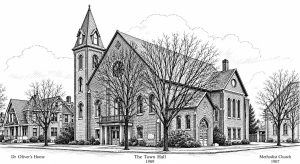
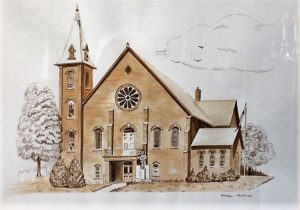
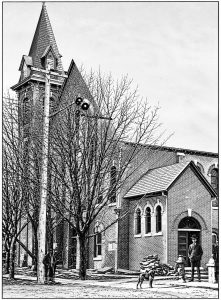
The new town hall served both Sunderland and the surrounding township. It contained the clerk’s office, council chamber, banquet hall, jail and a small library, as well as spaces for community activities and entertainment. A 1910 fire insurance map shows a farmers’ market operating on the ground floor and an opera house upstairs.
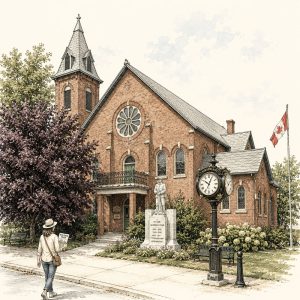
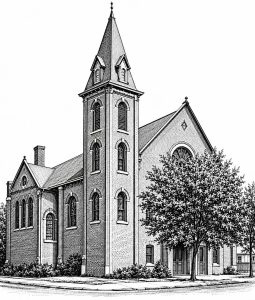
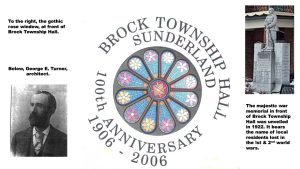
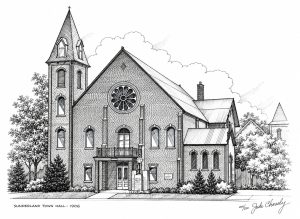
The building retains many distinctive architectural features. Its Romanesque windows have characteristic round arches, while the south wall facing River Street features an impressive circular, rose-shaped stained-glass window of Gothic design. Behind it is a large second-floor balcony containing original folding seats supplied by Robert Charter, Sunderland’s local furniture dealer and undertaker. Each seat even has a rack underneath where a gentleman could place his hat.
At the southwest corner stands the four-storey bell tower, where an iron bell once rang. Inside, the hall has an elaborate ceiling of pressed tin panels, a vaudeville-style stage with an old-fashioned ticket room, and a sloped concert floor.
The Town Hall became the social centre of Sunderland and the surrounding area. Its stage has hosted plays, musicals and community events, while the building was used for wartime fundraising and, for more than half a century, performances associated with the Sunderland Music Festival.
During the Great Depression of the 1930s, even the building’s jail cells found another use, providing overnight shelter for unemployed men passing through town in search of work.
In 1991, a Town Hall restoration committee worked with Brock Township and the Sunderland Lions Club to bring the historic building up to modern fire-code requirements. The project included major improvements to the washrooms and the installation of an elevator.
Standing in front of the Town Hall is Sunderland’s cenotaph. Erected in 1922, it originally commemorated local men who lost their lives while serving Canada during the First World War. The names of those lost during the Second World War were subsequently added, extending the memorial to another generation of Sunderland’s war dead.
2. Saint Andrews United Church – 10 Church St N
3. Sunderland Town Hall – 120 River St
4. Dr. Joseph Henry Oliver Home – 128 River St
5. St. Mary’s Anglican Church – 134 River St
6. Dr. James McDermott Home – 160 River St
7. The Fogg House – 198 River St
8. The Blacksmith Shop – 135 River St
9. The Nipissing House Hotel – 123 River St
10. Stop 4 Variety – 111 River St
11. The Old Drug Store – 108 River St
12. The Gigantic Hand Saw, Guardian Pharmacy – 103 River St
13. Fresh Mart – 97 River St
14. The Beall Block – 93 River St
15. The Harness Shop – 89 River St
16. Taylor’s Store – 85 River St
17. The William Doble Home – 32 Albert St
18. The Sunderland Presbyterian Church – 5 Albert St
19. Doyle’s General Store – 3 Albert St
20. The McDermott Block – 1 Albert Street S
21. The Sunderland Telephone Company. – 63 River St
22. James Doble Home – 3 Cedar St S
23. William Nassau Doble Home – 12 River St
24. Thomas Welsh Home – 20 River St
25. Robert Doble Home – 48 River St
26. The Bank – River Street (CIBC) – 74 River St
27. The Brock House Hotel – 82 River St
28. The Hardware Store – 92 River St
29. The Early Undertaker – 96 River St
30. The Printing Shop – 98 River St
31. The Magic Door – 100 River St
32. The Sunderland Legion – 104 River St
33. 108 River Street – 108 River Street
34. “Old” Fire Hall – 5 Church St N
35. The Sunderland Memorial Arena – 20 Park St