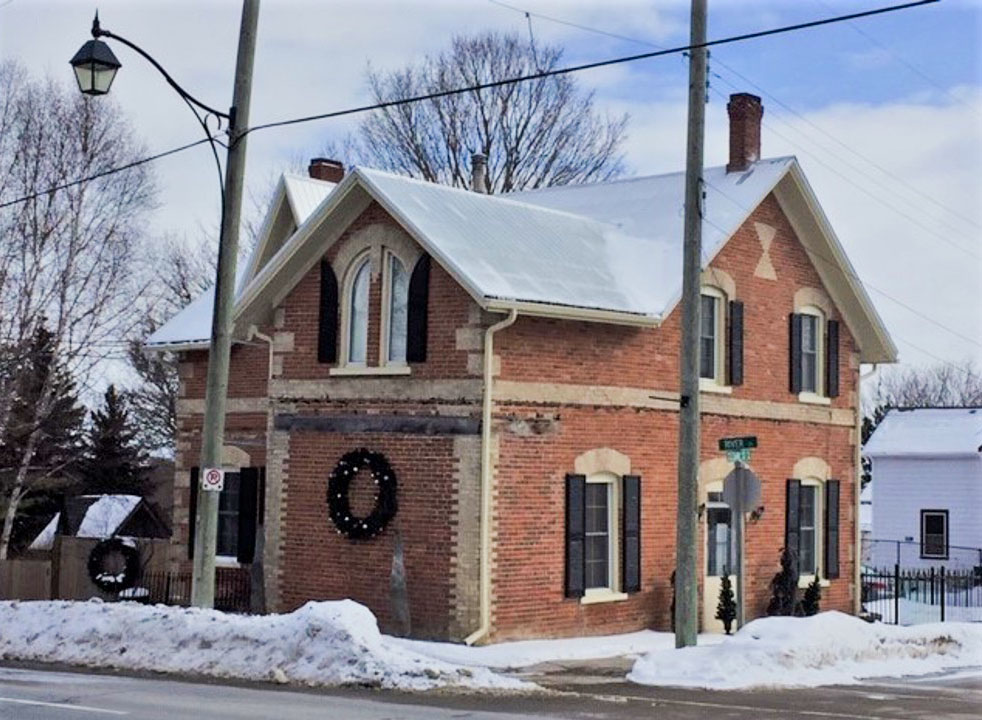
James Doble Home – 3 Cedar St S
James lived with his wife, Mary Jane Ray, at this house on the southeast corner of River and Cedar streets.
About 1900, Doble drew up a plan to develop much of his property along both sides of River Street. The plan included approximately 60 building lots extending from the area of Highway 12 east toward Albert Street. His influence on the development of this part of Sunderland was reflected in local street names, including Doble Street and James Street.
James Doble was also involved in banking in Sunderland. The Doble Bank was eventually sold to the Home Bank, which later operated beside Taylor’s Store on River Street. A remarkable reminder of Doble’s banking activities survived in his own home: the bank safe remained in the front living room of the house for many years.
Doble also donated land to local churches. In 1874, he provided the property for the rectory serving St. Mary’s Anglican Church. The rectory remained in use by Anglican ministers until about 1942. He also donated land to St. James West Brock Church for church picnics, summer gatherings and activities following services.
James died in 1907 and, like generations of the Doble family before him, was buried at St. James West Brock Cemetery. His will distributed numerous farms, houses and building lots among his nieces and nephews.
His widow, Mary Jane Ray, and stepdaughter, Lottie Ray, continued living in the Cedar Street home. Lottie later married West Doble and remained in the house until 1984.
James Doble was remembered within the family for his generosity. His nephews apparently discovered that this generosity could sometimes be encouraged. If they thought they might encounter Uncle James, they would wear their oldest, most battered shoes. James would take one look at their miserable footwear, scold them and promptly take them to the shoe store for a new pair.
Even after the family finally left the house, reminders of its long history remained. When the estate was sold, the home was filled with antiques—and later owners reportedly discovered money hidden within its walls.
2. Saint Andrews United Church – 10 Church St N
3. Sunderland Town Hall – 120 River St
4. Dr. Joseph Henry Oliver Home – 128 River St
5. St. Mary’s Anglican Church – 134 River St
6. Dr. James McDermott Home – 160 River St
7. The Fogg House – 198 River St
8. The Blacksmith Shop – 135 River St
9. The Nipissing House Hotel – 123 River St
10. Stop 4 Variety – 111 River St
11. The Old Drug Store – 108 River St
12. The Gigantic Hand Saw, Guardian Pharmacy – 103 River St
13. Fresh Mart – 97 River St
14. The Beall Block – 93 River St
15. The Harness Shop – 89 River St
16. Taylor’s Store – 85 River St
17. The William Doble Home – 32 Albert St
18. The Sunderland Presbyterian Church – 5 Albert St
19. Doyle’s General Store – 3 Albert St
20. The McDermott Block – 1 Albert Street S
21. The Sunderland Telephone Company. – 63 River St
22. James Doble Home – 3 Cedar St S
23. William Nassau Doble Home – 12 River St
24. Thomas Welsh Home – 20 River St
25. Robert Doble Home – 48 River St
26. The Bank – River Street (CIBC) – 74 River St
27. The Brock House Hotel – 82 River St
28. The Hardware Store – 92 River St
29. The Early Undertaker – 96 River St
30. The Printing Shop – 98 River St
31. The Magic Door – 100 River St
32. The Sunderland Legion – 104 River St
33. 108 River Street – 108 River Street
34. “Old” Fire Hall – 5 Church St N
35. The Sunderland Memorial Arena – 20 Park St