“Old” Fire Hall – 5 Church St N
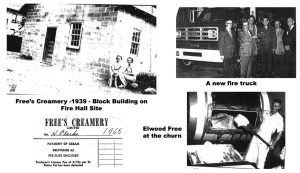
After studying at Guelph College and gaining experience working with his uncle at a creamery in Belleville, Elwood Free decided to establish his own business. In 1936, Elwood and his wife, Helen Rae, drew up plans and built Free’s Creamery at this location on Church Street North.
In the early days of the business, Elwood travelled throughout Brock Township collecting cream from local farms. At the creamery, the cream was churned into butter, shaped in wooden presses and individually wrapped in one-pound packages. The large cream cans returned by farmers were steamed and cleaned by hand.
About four years after opening, the Frees sold the Church Street building to the Township of Brock for use as Sunderland’s fire hall. The creamery operation moved to a new location on the east side of Highway 12, opposite Morrow Farm Equipment.
The relocated creamery continued to grow and modernize. New machinery dramatically increased production until as much as 2,200 pounds of butter could be prepared in an hour. Trucks delivered the butter to Toronto and often returned carrying feed for local farmers. The Free family eventually retired from the business, and Don Brooks later managed the operation from 1977 until 1991.
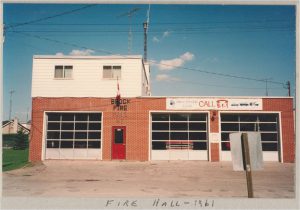
Meanwhile, the original creamery began its second life protecting the community as Sunderland’s fire hall.
The limitations of Sunderland’s early firefighting equipment became painfully apparent during the Great Fire of 1949, when the local fire truck broke down while the McDermott Block was burning. In 1950, Brock Township purchased a new GMC fire truck for approximately $10,000.
That historic GMC truck was carefully preserved and for many years continued to appear in local parades and community events. A second GMC fire truck was added to the department around 1970 as Sunderland’s firefighting equipment continued to improve.
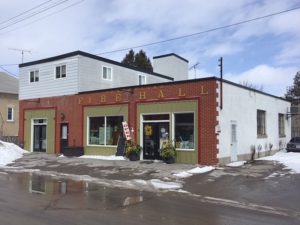
From making butter for local farm families to housing the equipment that protected the village from fire, this modest Church Street building has served two very different but important roles in Sunderland’s history.
2. Saint Andrews United Church – 10 Church St N
3. Sunderland Town Hall – 120 River St
4. Dr. Joseph Henry Oliver Home – 128 River St
5. St. Mary’s Anglican Church – 134 River St
6. Dr. James McDermott Home – 160 River St
7. The Fogg House – 198 River St
8. The Blacksmith Shop – 135 River St
9. The Nipissing House Hotel – 123 River St
10. Stop 4 Variety – 111 River St
11. The Old Drug Store – 108 River St
12. The Gigantic Hand Saw, Guardian Pharmacy – 103 River St
13. Fresh Mart – 97 River St
14. The Beall Block – 93 River St
15. The Harness Shop – 89 River St
16. Taylor’s Store – 85 River St
17. The William Doble Home – 32 Albert St
18. The Sunderland Presbyterian Church – 5 Albert St
19. Doyle’s General Store – 3 Albert St
20. The McDermott Block – 1 Albert Street S
21. The Sunderland Telephone Company. – 63 River St
22. James Doble Home – 3 Cedar St S
23. William Nassau Doble Home – 12 River St
24. Thomas Welsh Home – 20 River St
25. Robert Doble Home – 48 River St
26. The Bank – River Street (CIBC) – 74 River St
27. The Brock House Hotel – 82 River St
28. The Hardware Store – 92 River St
29. The Early Undertaker – 96 River St
30. The Printing Shop – 98 River St
31. The Magic Door – 100 River St
32. The Sunderland Legion – 104 River St
33. 108 River Street – 108 River Street
34. “Old” Fire Hall – 5 Church St N
35. The Sunderland Memorial Arena – 20 Park St