
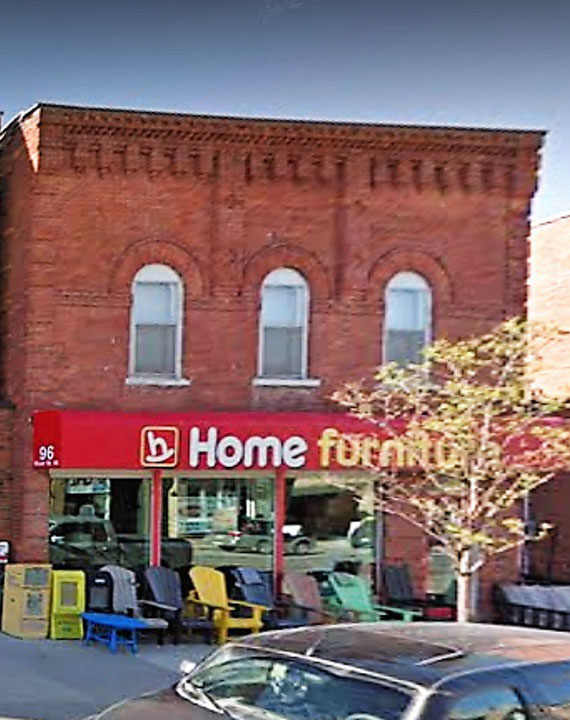
The Early Undertaker – 96 River St
One of the earliest undertakers recorded in the Sunderland area was G. A. Leach, who appears in the 1877 Ontario County Atlas.
By the early twentieth century, Robert Charter operated a furniture and undertaking business from this River Street building. Charter remained here until about 1915, providing Sunderland families with both household furnishings and funeral services.
His work also survives in another Sunderland landmark. In 1906, Charter supplied the folding seats for the new Sunderland Town Hall. Those original seats included a wire rack underneath where gentlemen attending a performance could place their hats.
After 1915, Lorne Pinkham took over the furniture and undertaking business. The building served several purposes at once: part of the main floor was used as a funeral parlour, other areas displayed furniture, and the Pinkham family also lived on the premises.
Despite becoming a businessman in town, Lorne maintained his connection to farming. A stable behind the store was large enough for two milking cows, and he rented farmland south of Sunderland. That property would much later become associated with the notorious Piggyland scheme of the early 1960s.
The next generation continued the family business when Ralph Pinkham took over around 1943. He operated it until 1969, when John Thorne came to Sunderland to assume the undertaking business.
In 1973, the funeral business became Thorne Memorial Chapel. Subsequent changes to the neighbouring properties separated the funeral home from the former Pinkham building, which eventually became part of the hardware and furniture business operated by the Pilgrim family.
The history of 96 River Street recalls an era when the village furniture maker might also build a family’s coffin, arrange the funeral and provide many of the furnishings found in the homes of the people he served.
2. Saint Andrews United Church – 10 Church St N
3. Sunderland Town Hall – 120 River St
4. Dr. Joseph Henry Oliver Home – 128 River St
5. St. Mary’s Anglican Church – 134 River St
6. Dr. James McDermott Home – 160 River St
7. The Fogg House – 198 River St
8. The Blacksmith Shop – 135 River St
9. The Nipissing House Hotel – 123 River St
10. Stop 4 Variety – 111 River St
11. The Old Drug Store – 108 River St
12. The Gigantic Hand Saw, Guardian Pharmacy – 103 River St
13. Fresh Mart – 97 River St
14. The Beall Block – 93 River St
15. The Harness Shop – 89 River St
16. Taylor’s Store – 85 River St
17. The William Doble Home – 32 Albert St
18. The Sunderland Presbyterian Church – 5 Albert St
19. Doyle’s General Store – 3 Albert St
20. The McDermott Block – 1 Albert Street S
21. The Sunderland Telephone Company. – 63 River St
22. James Doble Home – 3 Cedar St S
23. William Nassau Doble Home – 12 River St
24. Thomas Welsh Home – 20 River St
25. Robert Doble Home – 48 River St
26. The Bank – River Street (CIBC) – 74 River St
27. The Brock House Hotel – 82 River St
28. The Hardware Store – 92 River St
29. The Early Undertaker – 96 River St
30. The Printing Shop – 98 River St
31. The Magic Door – 100 River St
32. The Sunderland Legion – 104 River St
33. 108 River Street – 108 River Street
34. “Old” Fire Hall – 5 Church St N
35. The Sunderland Memorial Arena – 20 Park St