
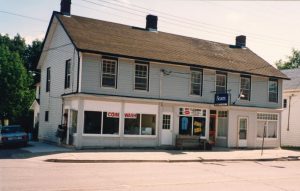
The Nipissing House Hotel – 123 River St
The original hotel was a long frame building extending west along River Street from Church Street South. It became an important gathering place as well as accommodation for travellers. Boxing and wrestling matches and dances were held there. Mr. Collins, a local resident, reportedly kept gamecocks at the rear of the property and staged bird fights to entertain hotel guests—a form of entertainment that would be unacceptable today.
Thomas Fogg became closely associated with the Nipissing House. He was listed as its proprietor as early as 1891, and a 1912 photograph shows a large sign on the building reading “Nipissing House – Fogg.” He continued operating the hotel into the early twentieth century.
One colourful story associated with the Nipissing House involves Tom Longboat, the celebrated Onondaga long-distance runner from Six Nations of the Grand River. While staying at the hotel, Longboat reportedly wagered that he could outrun a man driving a horse and buggy. He won the race back to the hotel with ease.
Over time, the long hotel building was divided and altered. A section at the west end was separated from the main structure, turned 90 degrees and repositioned to face River Street. A second-storey walkway once connected portions of the complex, but it was removed in 1917, after which the buildings became separate properties.
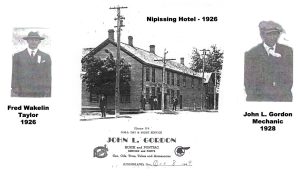
After Thomas Fogg lost much of his fortune through unsuccessful investments, John L. Gordon acquired part of the former hotel property for an automobile repair business. Gordon’s Garage was later sold to Goodison Threshing Mills and eventually became a Pontiac-Buick dealership. Herb Thompson worked there as an accountant.
The Gordon business also played a part in Sunderland’s firefighting history. Following the devastating Sunderland fire of 1949, the Gordons sold the Township of Brock a new GMC fire truck in 1950. The historic truck has been preserved in remarkably good condition.
Other portions of the former Nipissing House accommodated a succession of businesses. Fred Wakelin operated a tailor shop in part of the building for more than 20 years beginning around 1930. Stan Will and his wife, Myrtle Snowden, later operated a Tip Top tailor store, selling dry goods, clothing and chinaware. Other businesses over the years included a bakery, variety store, florist and Carl Umphrey’s barber shop.
In 1967, the former garage was sold to Charles Thompson and converted into a residence. The surviving Nipissing House complex was subsequently adapted for apartments and commercial use, preserving portions of a building that has stood at this important Sunderland intersection since 1870.
2. Saint Andrews United Church – 10 Church St N
3. Sunderland Town Hall – 120 River St
4. Dr. Joseph Henry Oliver Home – 128 River St
5. St. Mary’s Anglican Church – 134 River St
6. Dr. James McDermott Home – 160 River St
7. The Fogg House – 198 River St
8. The Blacksmith Shop – 135 River St
9. The Nipissing House Hotel – 123 River St
10. Stop 4 Variety – 111 River St
11. The Old Drug Store – 108 River St
12. The Gigantic Hand Saw, Guardian Pharmacy – 103 River St
13. Fresh Mart – 97 River St
14. The Beall Block – 93 River St
15. The Harness Shop – 89 River St
16. Taylor’s Store – 85 River St
17. The William Doble Home – 32 Albert St
18. The Sunderland Presbyterian Church – 5 Albert St
19. Doyle’s General Store – 3 Albert St
20. The McDermott Block – 1 Albert Street S
21. The Sunderland Telephone Company. – 63 River St
22. James Doble Home – 3 Cedar St S
23. William Nassau Doble Home – 12 River St
24. Thomas Welsh Home – 20 River St
25. Robert Doble Home – 48 River St
26. The Bank – River Street (CIBC) – 74 River St
27. The Brock House Hotel – 82 River St
28. The Hardware Store – 92 River St
29. The Early Undertaker – 96 River St
30. The Printing Shop – 98 River St
31. The Magic Door – 100 River St
32. The Sunderland Legion – 104 River St
33. 108 River Street – 108 River Street
34. “Old” Fire Hall – 5 Church St N
35. The Sunderland Memorial Arena – 20 Park St