
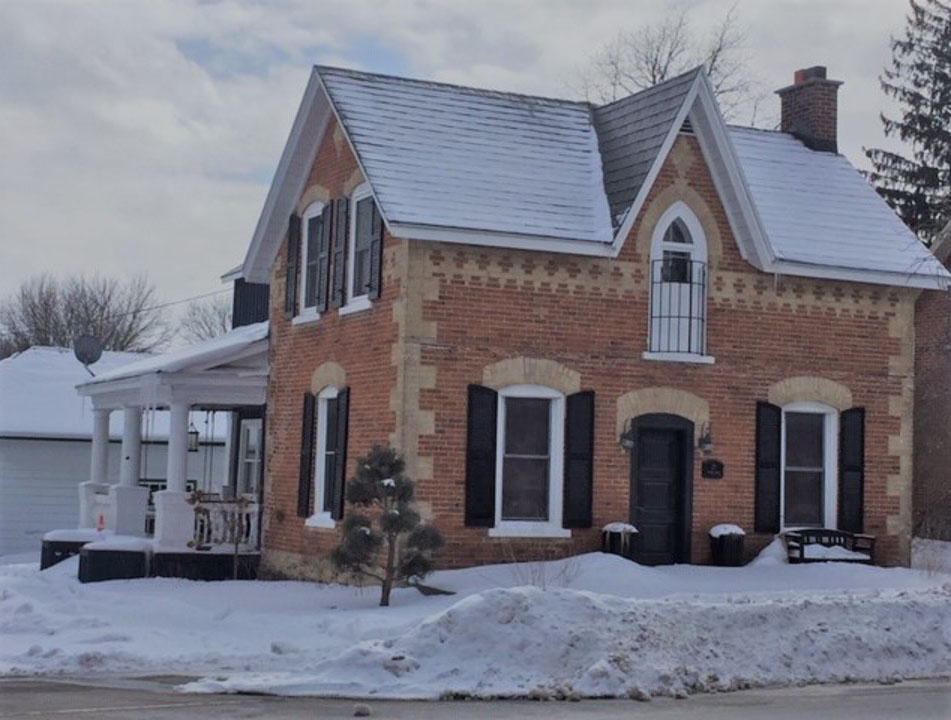
Thomas Welsh Home – 27 River St
Welsh’s mill also played an unusual role in bringing electricity to Sunderland. By 1916, the mill had a steam-powered generator. During the day, it supplied power to operate the mill; at night, the generator provided electricity to the village until midnight. The milling business later became part of the Sunderland Co-Op in 1950.
Thomas Welsh also served the community as postmaster for more than 30 years, from 1894 until 1925. His son Arthur then took over as postmaster and served until 1939. During the Second World War, Arthur’s wife, Ruby Miller, continued the family’s association with the post office, serving until 1945.
Arthur Welsh had a distinguished military career. He served as a pilot during the First World War and returned to military service during the Second World War, when he commanded an anti-tank battery. In 1945, he was decorated by General Bernard Montgomery for his actions during the Italian Campaign.
Arthur also pursued a career in public service. He served as a Member of the Ontario Legislature and later as Sheriff of Ontario County. He and Ruby eventually moved to Whitby, and the Sunderland house passed to their son Tom in 1956.
The appearance of the Welsh home evolved along with the family. A 1906 view shows a white picket fence and wooden porch. In 1920, a substantial new concrete porch was added along the north and east sides of the house, with large pillars supporting upper balconies. A large maple tree also became a prominent feature at the northeast corner of the property.
The Welsh home recalls a family whose activities touched many aspects of Sunderland life—from milling grain and operating the post office to providing some of the village’s earliest electric power.
2. Saint Andrews United Church – 10 Church St N
3. Sunderland Town Hall – 120 River St
4. Dr. Joseph Henry Oliver Home – 128 River St
5. St. Mary’s Anglican Church – 134 River St
6. Dr. James McDermott Home – 160 River St
7. The Fogg House – 198 River St
8. The Blacksmith Shop – 135 River St
9. The Nipissing House Hotel – 123 River St
10. Stop 4 Variety – 111 River St
11. The Old Drug Store – 108 River St
12. The Gigantic Hand Saw, Guardian Pharmacy – 103 River St
13. Fresh Mart – 97 River St
14. The Beall Block – 93 River St
15. The Harness Shop – 89 River St
16. Taylor’s Store – 85 River St
17. The William Doble Home – 32 Albert St
18. The Sunderland Presbyterian Church – 5 Albert St
19. Doyle’s General Store – 3 Albert St
20. The McDermott Block – 1 Albert Street S
21. The Sunderland Telephone Company. – 63 River St
22. James Doble Home – 3 Cedar St S
23. William Nassau Doble Home – 12 River St
24. Thomas Welsh Home – 20 River St
25. Robert Doble Home – 48 River St
26. The Bank – River Street (CIBC) – 74 River St
27. The Brock House Hotel – 82 River St
28. The Hardware Store – 92 River St
29. The Early Undertaker – 96 River St
30. The Printing Shop – 98 River St
31. The Magic Door – 100 River St
32. The Sunderland Legion – 104 River St
33. 108 River Street – 108 River Street
34. “Old” Fire Hall – 5 Church St N
35. The Sunderland Memorial Arena – 20 Park St