
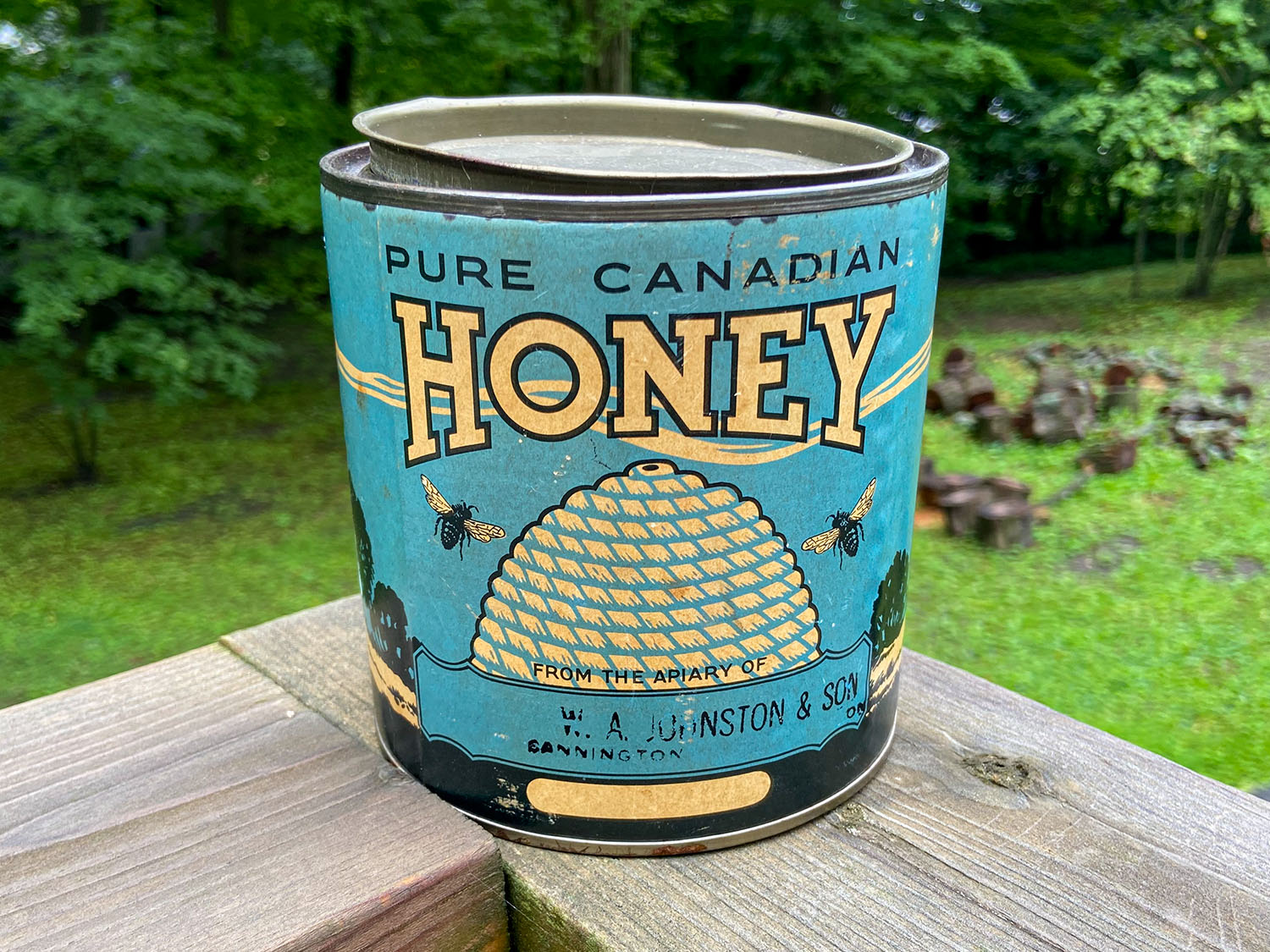
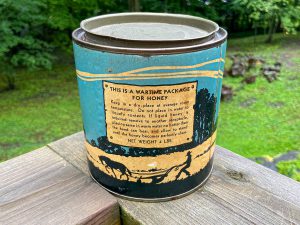


During the Second World War, even an ordinary container of honey became part of Canada’s war effort. Metal was needed in enormous quantities for military equipment, vehicles, ships, aircraft and countless other wartime uses. Tinplate—the thin sheet steel coated with tin that was commonly used for food containers—was therefore a material to be conserved wherever possible.
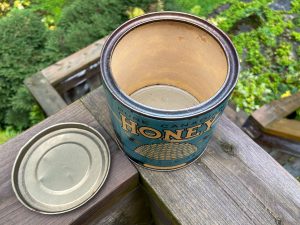
Honey presented a particular problem. Canadian beekeepers still needed containers in which to package and sell their crop, but the familiar all-metal honey tin used a significant amount of metal. In April 1942, the Canadian government restricted the use of tinplate for honey containers to standard 4- and 8-pound sizes. Manufacturers responded by developing containers that used fibreboard for the cylindrical body while retaining metal only where it was most necessary: the lid, bottom and reinforcing rims.
The result looked much like a conventional honey tin but used substantially less metal. The thick fibreboard body was strong enough to hold four pounds of honey while conserving tinplate for more important wartime purposes.
The Sunderland Museum example uses a standard generic label customized by overprinting the beekeeper’s name. This allowed the same basic container to be supplied economically to many individual apiaries.
Based on Canadian beekeeping suppliers operating during this period, F. W. Jones & Son Ltd. of Bedford, Quebec, appears to be the strongest candidate for the manufacturer. The company was a major Canadian supplier of beekeeping equipment and packaging, and surviving Jones packaging uses similar wording, including “From the Apiary of…” However, without a manufacturer’s mark or documentary evidence directly linking this particular container to Jones, the attribution should be considered probable rather than confirmed.
At first glance, the wartime container does not appear to have saved very much material. The Museum’s conventional four-pound all-metal honey tin weighs 171 grams, while the composite fibreboard container weighs 155 grams—a difference of only 16 grams.
But that comparison is misleading.
The fibreboard itself is surprisingly substantial. The wall is approximately 0.096 inches (2.44 mm) thick, with an outside circumference of 40.3 cm and an exposed height of 12.14 cm. From these measurements, the fibreboard wall contains approximately 117 cubic centimetres of material.
Depending on the density of the fibreboard, we estimate that the paper portion alone weighs approximately 76 to 94 grams. The complete composite container weighs 155 grams, including its 25-gram metal lid, metal bottom and reinforcing rims.
This means the composite container probably contains only about 61 to 79 grams of metal, compared with 171 grams in the conventional all-metal tin.
The surprising result
The wartime design may therefore have saved approximately 92 to 110 grams of metal for every four-pound honey container produced—roughly 100 grams per container.
That represents a reduction of approximately 55 to 65 percent in the amount of metal required.
So, although the wartime container weighs only 16 grams less than its all-metal counterpart, its real contribution to the war effort was much greater. The missing metal had simply been replaced by thick, strong fibreboard.
Multiply a saving of about 100 grams by thousands—or hundreds of thousands—of honey containers, and an apparently small change in packaging becomes a significant conservation of strategically important metal.
Comments:
Ralph Maleus added: Fibre board packages are all or partly based on renewable material. In this case, the fibre comes from the forest while metal is extracted from the ground.