
About Our Fair
Celebrating 173 years, the Sunderland Fall Fair is the oldest fair in Durham Region and is and always has been a mid-week fair that focuses greatly on our youth. It originated as the Sunderland Rural Fair with the first day dedicated to the children. Today, the Fair opens at 4.00 p.m. on Tuesday afternoon and continues throughout the day on Wednesday. We still enjoy strong participation on Wednesday from our local schools. The two elementary schools participate in the parade and vocalize their “School Cheers” which can be heard while you enter the fairgrounds, the high school band provides the Parade’s musical entertainment.
Fair Book 2012 Article
Article
NESTLED IN THE ROLLING HILLS and rambling pastures of Brock Township is the home of the Sunderland Fall Fair, the oldest fair in Ontario’s Durham Region. This fair’s origin is traced to 1851, when a rural school fair combined with a farm exhibition in a celebration of the community’s rural history, culture and val-ues. Throughout its 161 years, the fair has stayed true to its roots and mission in its “promotion of agriculture and rural life”.
The Sunderland Fall Fair is a mid-week event providing one of the great social gatherings of the year drawing spectators and participants from far and wide. The children from the two local elementary schools are excused from class to march in the parade and compete in various challenges. The parade begins at Sunderland Public School where the judging of floats, costumes and decorated bicycles takes place and ends in front of the grandstand on the fair grounds where the school cheer competition is judged. Literacy contests as well as baking and craft exhibitions can be viewed in the arena. The spelling bee, in both English and French, tests the skills and highlights the abilities of our future leaders. Classes exclusive to young exhibitors allow children to showcase the flowers and vegetables that they have nurtured during the summer.
Local 4-H beef and dairy clubs hold their achievement days at the fair to the delight of our young farmers. The 4-H Motor-heads vie for top honours with their ‘tweaked” lawn tractors providing lots of action and noise in the tractor pull competition.
The giant vegetable produce is amazing! In the arena, specimens of corn stalks touch the ceiling. Pumpkins weigh in at over 1000 pounds and root crops are gargantuan.
Horse lovers will delight in their visit to the fair. The light horse show has a large following. Competitors travel long distances to participate in this event’s wide-ranging demonstration of showmanship and horsemanship. The heavy horse show is a two day affair. The horse pull occurs on Tuesday night and the draft horses and ponies are shown on Wednesday. The line
classes are judged first followed by the hitch classes. The emerging skills of junior horsemen are recognized in a special class exclusive to young peolpe who have not yet reached their 18th birthday.
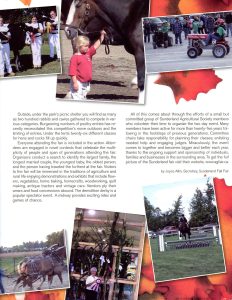
Outside, under the park’s picnic shelter you will find as many as two hundred rabbits and cavies gathered to compete in various categories. Burgeoning numbers of poultry entries has recently necessitated this competition’s move outdoors and the limiting of entries. Under the tents twenty-six different classes for hens and cocks fill up quickly.
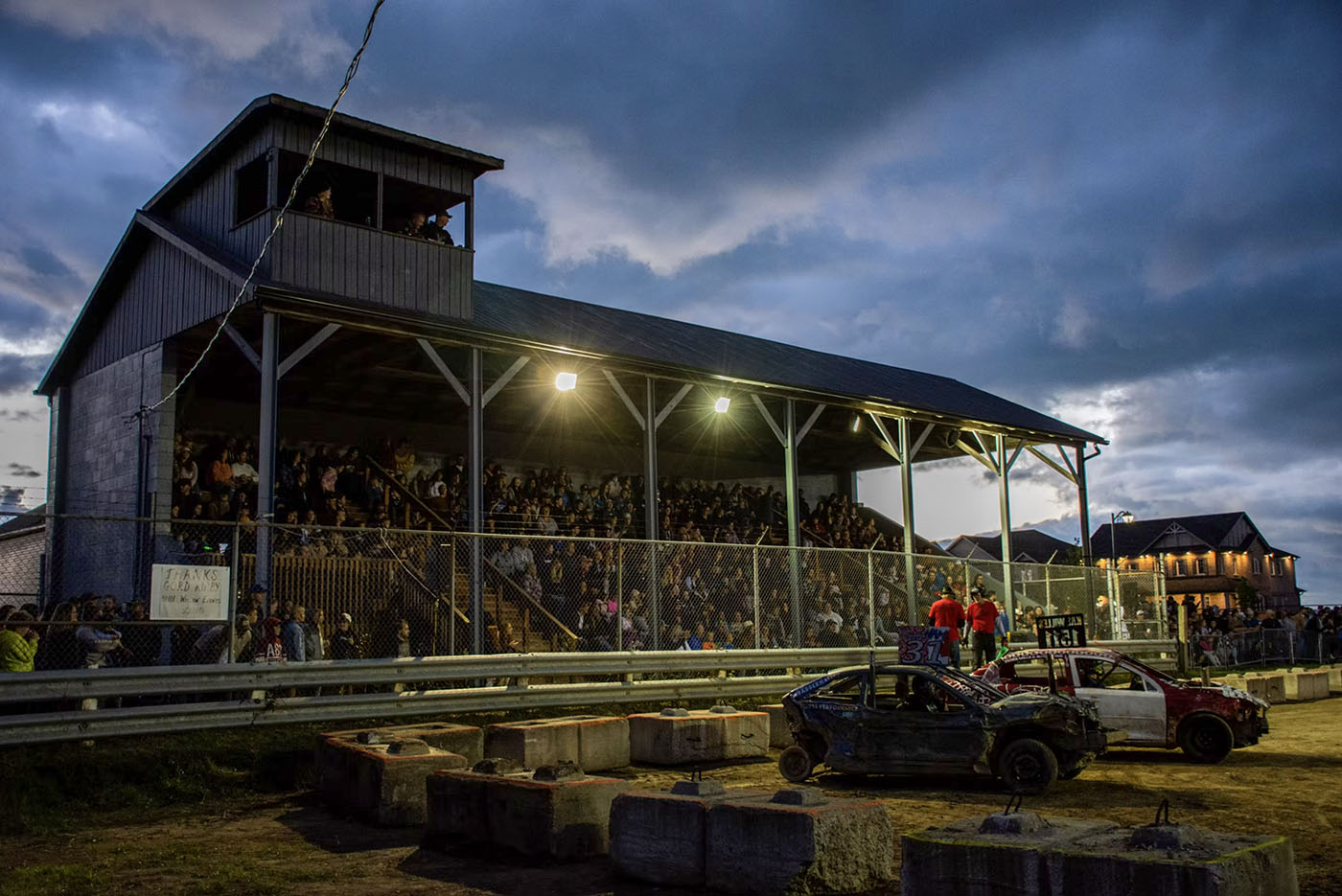
Everyone attending the fair is included in the action. Attendees are engaged in novel contests that celebrate the multiplicity of people and span of generations attending the fair. Organizers conduct a search to identify the largest family, the longest married couple, the youngest baby, the oldest person, and the person having traveled the furthest at the fair. Visitors to the fair will be immersed in the traditions of agriculture and rural life enjoying demonstrations and exhibits that include flow-ers, vegetables, home baking, homecrafts, woodworking, quilt making, antique tractors and vintage cars. Vendors ply their wears and food concessions abound. The demolition derby is a popular spectator event. A midway provides exciting rides and games of chance.
All of this comes about through the efforts of a small but committed group of Sunderland Agricultural Society members who volunteer their time to organize the two day event. Many members have been active for more than twenty-five years following in the footsteps of previous generations. Committee chairs take responsibility for planning their classes, enlisting needed help and engaging judges. Miraculously, the event comes to together and becomes bigger and better each year, thanks to the ongoing support and sponsorship of individuals, families and businesses in the surrounding area. To get the full picture of the Sunderland fair visit their website, www.agfair.ca.
by Joyce Allin, Secretary, Sunderland Fall Fair
Presentation on the Sunderland Fall Fair 2011
What constitutes an “agricultural fair”? The answer is, Livestock and Agricultural products with most fairs remaining true to their mission statement of “promoting agriculture and rural life”. What is interesting about Sunderland Fair is that it also historically included a School Fair for the children to be involved in and offered midweek so that the local schools could be part of the educational opportunity that the fair offered.
The first Sunderland Fair was organized by the Brock Agricultural Society in 1851 and included a Merry-Go-Round.
Some years later Mr. St. John donated the present fairgrounds to the society.
By 1887 The Brock Agricultural Society’s fair was held on Monday, Tuesday and Wednesday at the beginning of October.
In 1904 Railway arrangements had been made with Grand Trunk Railway (GTR) for excursion rates on both days of the show. This year the fair was held on Tuesday and Wednesday.
An example of classes from 1904 included: Class 9, Domestic Manufactures – such as 5 yards of full cloth, home-made; A coverlet; pair of woolen mitts. For Class 12 this included work “by girls under 12 years of age” – with classes for a trimmed cotton pinafore, two pairs of socks or stockings etc. Class 13 was listed as “Farm Implements and Manufactures” which included such items as a turnip drill, horse rake, gang plough or a specimen of cooper’s work.
In 1920 the first exhibit hall was a frame building which was used for skating in the winter.
In 1931 The Rural School Fairs were sponsored by the Ontario Department of Agriculture and organized by the local agricultural representative. The Department of Agriculture gave seeds to the school children in the spring so that the children could plant and care for vegetables and flowers then exhibit them at fairs. The children had to place the seed package with their entries which encouraged new varieties of seeds to be discovered. Prizes were donated by T. Eaton Company and the Ministry of Agriculture.
In 1937 The Fall Exhibition was for two days, one for the children (School Fair) and the next for adult entries. The School Fair included a parade, physical drill and money prizes for students in agricultural classes, public speaking, spelling match, and instrumental solos to name a few.
After WW2 the township built a new memorial arena, north of the frame building. It was at this time that the agricultural society turned the grounds over to the township.
In 1946 Junior Farmers competed at the fair.
In 1949 a Memorial Arena was built after WW2
In 1951 new entrance gates were erected to commemorate the 100th anniversary
In 1957 the old wooden grandstand was flattened in a windstorm.
In 1965 the name of the society was changed from the Brock Agricultural Society to the Sunderland Agricultural Society.
In 1974 was the first Fair Queen Competition with three contestants.
The Lions built a new front on the arena. The dressing rooms were enlarged and an air-conditioned auditorium created upstairs.
In 1979 the first Tractor Pull was held.
In 1981 the first Demolition Derby took place on the Wednesday night and the first Horse Pull was held. The Horse Pull replaced the Horse race event.
In 1984 Brock Township, the Lions and the Fair Board all worked together to build washrooms along the west side of the arena allowing access both inside and outside the arena. The cost was $27,720
In 1985 the first Service Award was presented to Harold Doble.
In 1993 saw the beginning of the giant vegetable class
In 2000 the grandstand, food booth and barn were painted. A new chain-link fence was installed around part of the fairgrounds. Three new bleachers were built.
In 2001 a horse plowing demonstration and competition was introduced. A spelling bee becomes part of the fair.
The fair continues to evolve, drawing neighbours and visitors from afar and proudly remembering and celebrating the Agricultural roots of this community. The fair board is operated by scores of volunteers, many who have given decades of service to this event. Be sure to pop onto the Sunderland Agricultural Society and Agricultural Fall Fair website to see the full schedule for this years events and bring your family out to enjoy one of the longest traditions of Brock’s history.