
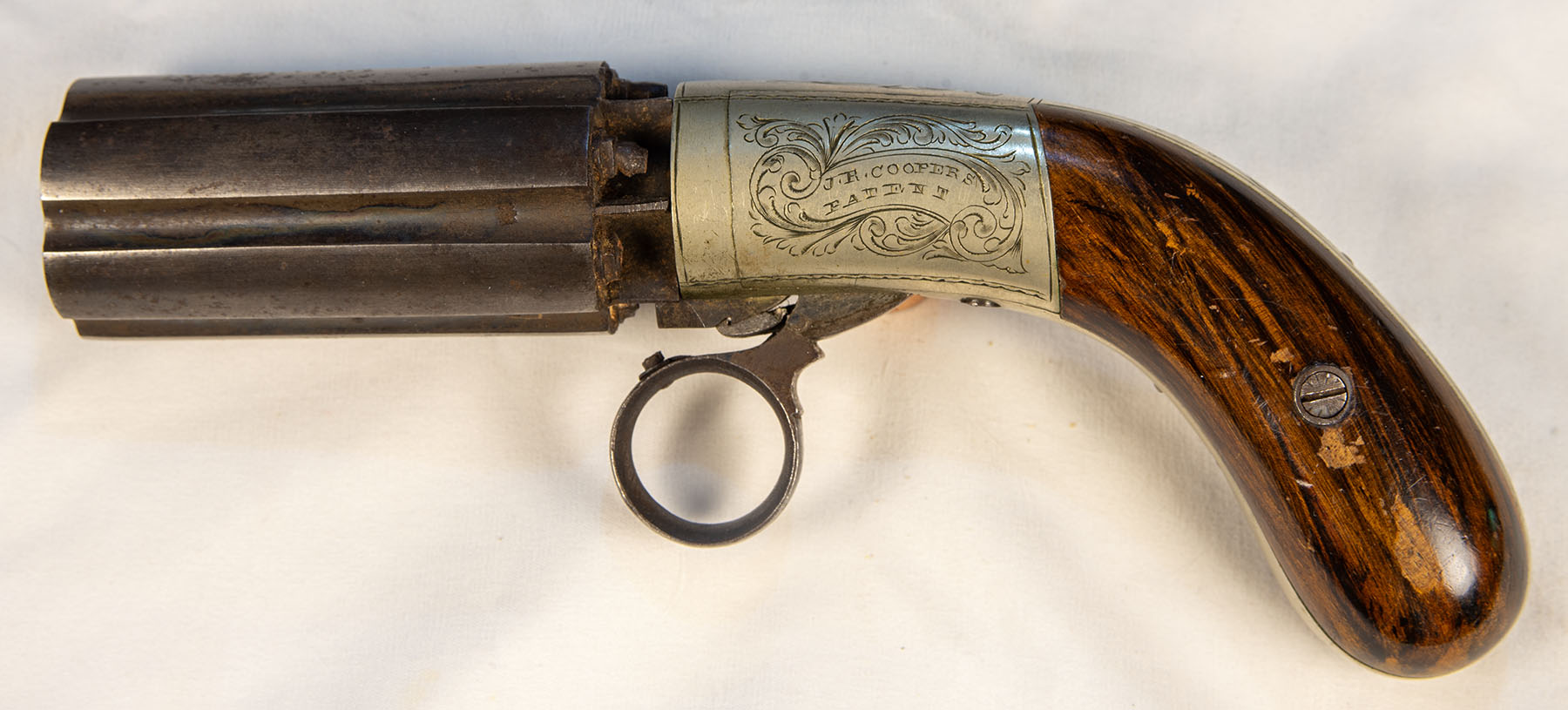
For four generations, the most cherished possession of the Bagshaw family of Brock Township was a small six-barreled pistol, handed down, like the name William itself, from father to son. By family tradition it had ridden at Waterloo in the hand of a British cavalryman, fortunate to come away alive from the great contest against Napoleon. It is a splendid story, and almost certainly an impossible one. The pistol itself says so.
The man at the head of the line was William Bagshaw, born in Staffordshire, England, on February 13, 1783. In the spring of 1817 he left for Upper Canada and took up two hundred acres of bush in Brock Township, in what was then the County of Ontario. He prospered there in the manner of the useful pioneer: “Squire” Bagshaw, justice of the peace and the township’s first postmaster, a man who married couples, buried the dead, surveyed his neighbors’ farms, and settled their disputes.
His wife, Sarah (Bolton) Bagshaw, born in 1786, was left behind in England while William broke ground on the homestead, and for two years his letters failed to reach her. Believing herself a widow, she went into mourning, until at last a letter arrived to report that her husband was alive and landholding in Canada. On Easter Sunday, April 18, 1819, she boarded a sailing vessel with eight children. The crossing took eleven weeks and three days. A broken leg kept William from meeting them at York (now Toronto), so Sarah set out on foot with the children and walked some forty-five miles to Quaker Hill, near Uxbridge. Reunited at last, the family was raising the walls of its log shanty, on Lot 5 of Concession 9, on Christmas Day, 1819. From that one-windowed cabin, its chinks packed with lime mortar and its roof laid up of basswood troughs, came seventeen children and a homestead that descended through the generations: a hewn-log house in 1830, and a fine stone residence in 1890 that was still standing when this story was first set down.
The heirloom that anchors the family’s memory is a percussion pepperbox revolver, roughly ten inches in length, its six barrels turned from bright steel and its engraved frame dressed with silver. Each barrel was charged from the muzzle with powder, wad, and ball, and fired by a percussion cap seated at the breech, so that six shots stood ready without reloading. Stamped into the metal are the words that settle the question of its age: “J. R. Cooper’s Patent.”
That mark belongs to Joseph Rock Cooper, a Birmingham gunmaker active from the late 1830s into the 1860s, and remembered above all for his pepperbox pistols. The design the Bagshaw gun carries rests on Cooper’s English patents of 1840 and 1843. The pistol was therefore made in the early-to-middle 1840s, a full generation after Waterloo, which was fought in June of 1815.
Here the cherished tradition meets two facts it cannot survive. The first is mechanical: the percussion cap that fires this gun was a technology of the 1820s and after, unknown on the field at Waterloo, and the multi-barreled pepperbox was a creature of the 1830s and 1840s entirely. The second is the family’s own chronicle. William Bagshaw was settled in Brock Township by 1819, fully two decades before this pistol was so much as filed and engraved on a Birmingham bench. Whatever a Bagshaw may have carried against Napoleon, it was not this gun, for this gun did not yet exist.
How, then, did it come to a pioneer farmhouse in the Ontario bush? The honest answer is that no document yet located will say, but the likeliest paths are not hard to imagine. A pepperbox of the 1840s might have been sent out from England to relations already established in Canada; it might have been purchased outright in York or Whitby, where British goods moved freely; or it might have come west in the hands of a later Bagshaw and, in time, drifted backward through the family’s memory until it attached itself to the founding patriarch and his Waterloo. Heirlooms gather such legends the way a barrel gathers patina. The wonder is not that the story grew, but that the gun beneath it is the more interesting object once the legend is lifted away.
For what the Bagshaw pistol truly belongs to is one of the briefest and most colorful moments in the history of the handgun: the crowded heyday of the multi-barreled pepperbox, a compact and affordable repeater that put six shots at an ordinary person’s fingertips in the years just before Samuel Colt’s single-barreled revolver swept the whole type into obsolescence. It is a creditable piece of English gunmaking at its mid-century best, and almost certainly it reached the Bagshaws in Canada, the prized possession of a prospering settler family rather than a souvenir of a European battlefield.
The gun never saw Waterloo. It saw something rarer: the long, ordinary endurance of a family that crossed an ocean, walked to its own front door, and kept one small thing safe for a hundred years.
The family narrative follows a 1950 account of the Bagshaws of Sunderland and Brock Township, corroborated against Ontario genealogical records. The firearm’s date rests on the “J. R. Cooper’s Patent” marking and the documented dates of Joseph Rock Cooper’s English patents of 1840 and 1843.
Sunderland Man Has Pistol Used in the Battle of Waterloo
William T. Bagshaw, popular citizen of Sunderland has in his possession a muzzle loading horse pistol, which his great grandfather, William Bagshaw brought to Brock Township, when he emigrated from England to Canada on April 9th, 1817. This unique weapon was used by his grandsire in the Battle of Waterloo, where he was enlisted in the British Cavalry.
Mr. Bagshaw is a descendant of William Bagshaw and his wife the former Sarah Bolton, two of the earliest pioneers, who settled in Brock Township in 1819 and who were his great grandparents.
This pistol, upon examination, proves to be a firearm of the finest workmanship and materials. The gun is approximately 10 inches in length; the barrel has six revolving type chambers made of the best and most excellent steel of that early date. Its stock is made of the choicest of red woods overlaid with silver plating, beautifully engraved and carrying the inscription “J.R. Cooper’s patent.” The whole pistol is a model which speaks of the excellent materials and craftsmanship in which the world’s workers vied at that date of long ago.
The present Mr. W. Bagshaw of Sunderland says, “My great grandfather carried this pistol as he rode in the Battle of Waterloo in which the English fought against Napoleon Bonaparte, and out of which my grandfather was fortunate to emerge alive.”
Mr. Bagshaw explained that each of the revolving six chambers in the barrel of the gun had to be muzzle-loaded with gun powder and wadding, which was sealed with a bullet at the gun’s point and cap at the trigger end. Thus six bullets could be fired without reloading. The pistol has been passed on as a family heirloom from its first possessor to his descendants in the succeeding generation who bore his name William, this, it has been passed to the present William T. Bagshaw from his father, William Bagshaw, son of the earliest Bagshaw pioneer.
It is interesting to note from entries made in an old family Bible which Mr. W.T. Bagshaw, now of Sunderland, has in his possession and which was presented to his great-grandfather’s mother, in November 5th, 1757, that his great grandsire was born February 13th, 1733 in the Parish of Alistone, Field, County Staffordshire, England. He emigrated to Canada on April the 9th, 1817, and became Squire Bagshaw and Justice of the Peace, marring, burying, surveying farms and settling disputes.
He was also the first postmaster of Brock Township. His wife, the former Sarah Bolton, who was born on June 19th, 1786, at Horham, Suffolk, England, did not emigrate to Canada until two years after her husband. During the wait in England between 1817 and 1819 she went in mourning as his letters had gone astray and she thought him dead. However, finally a letter was received by her saying that her husband had 200 acres of good land in Canada in Brock Township, County of Ontario.
Accordingly, she set sail for Canada on Easter Sunday, April 18th, 1819, with her eight children. It took 11 weeks and three days to cross the Atlantic Ocean in a sailing vessel. On account of a broken leg, her husband, William Bagshaw, did not meet her at York, now Toronto, so with the children, she walked 45 miles to Quaker Hill near Uxbridge, where they stayed three months.
Mr. and Mrs. Bagshaw and family, thus reunited, were building their shanty on lot five, concession 9, Brock Township on Christmas Day, 1819. Here, with courage, prudence and toll, these pioneers laid the foundation of the present Bagshaw family, which spreads over a wide territory in North America today, their own family increasing to 17 children of whom 14 lived a long life.
It was from here the Bagshaw family had to travel on foot at first, later by ox cart, through the blazed forest wilderness, or later over the corduroy roads made by laying logs side by side and covered with earth, to Whitby or Toronto, some 55-60 miles, to buy and sell such products as grain. Their house was small and built of logs, the chinks being filled with wood and mortar, made from burnt limestone. The roof was made of basswood troughs. After a time, glass was carried some 60 miles from Toronto for one window.
The furniture was homemade, with a ladder to reach the upstairs room. The fireplace was large enough to take a “backlog,” then another log was rolled to it and the split wood piled above and the fire was lit. The family gathered around the fireplace at night and told stories, the father and young men smoking, while the mother and girls spun wool into yarn. Books and newspapers were very scarce and precious.
The second home of the Bagshaw family was built in 1830 on the same sight as the former one, out of round hewn logs. It was a large substantial building, and the home of the present Mr. Bagshaw’s grandfather. In 1890 it was torn down and, in its place, a splendid stone house was erected by William Bagshaw, father of the present Mr. Bagshaw. This fine residence with its excellent materials and beautiful architecture still stands today, a noble heritage for succeeding generations.
Today it is the residence of Mr. G.H. Bagshaw, who holds the original deed of the land, from the crown, and who is a brother of William T. Bagshaw.
Mr. Bagshaw of Sunderland spent the first 27 years of his life on this fertile 200-acre farm in Brock, until his marriage to Miss Mary Glendenning 46 years ago. At that date, in 1903, he bought the Samuel Shier property, which is known as lot 5, concession 5 Brock and called Clear Spring Farm. In 1914 he replaced the frame house with a splendid red brick house which stands there today.
Stouffville Tribune – March 30, 1950